
Greek Philosophers’ Concept of Matter
Greek philosophers believed that everything in the universe is made of a basic substance called an element. Some thought that this element was water, while others believed it was air. They tried to explain the nature of matter using simple ideas, although these were not based on experiments.
Corpuscular Theory of Matter
The corpuscular theory states that matter is made up of very small particles called corpuscles. Greek philosophers like Empedocles and Democritus presented this idea in the 5th century BC. This theory laid the foundation for modern atomic theory.
Views of Empedocles, Plato and Aristotle
Empedocles suggested that all matter is made up of four basic elements: earth, air, water, and fire. Plato supported this idea and named these substances as elements. Aristotle further explained that these elements are formed by combining four qualities: hot, cold, wet, and dry. These ideas remained important for many centuries.
Definition of Chemistry
Chemistry is a branch of science that deals with the study of matter, its composition, properties, and the changes it undergoes. It helps us understand the substances around us and how they react with each other.
Statements for Each Branch of Chemistry
Analytical Chemistry
Analytical chemistry helps in determining the composition and purity of substances. For example, elemental analysis shows the elements present in ammonia, and experiments are performed to determine the percentage purity of glucose. Measuring melting point is also an important analytical method.
Biochemistry
Biochemistry studies chemical processes in living organisms. Photosynthesis in plants produces food using sunlight, and proteins like keratin are found in hair and nails. Many chemical reactions occur inside the human body to maintain life.
- Environmental Chemistry
Environmental chemistry deals with the impact of chemicals on the environment. Pollutants like nitrogen dioxide and sulphur dioxide cause acid rain, and vehicle exhaust gases pollute the air. Plantation helps reduce the greenhouse effect and protect the environment.
- Inorganic Chemistry
Inorganic chemistry focuses on substances other than carbon compounds. Ammonia is an example of an inorganic compound, and metals like silver can react with air and tarnish. This branch studies properties of metals, minerals, acids, bases, and salts.
- Industrial Chemistry
Industrial chemistry involves large-scale production of chemicals. The Haber process is used to manufacture ammonia, and cement is produced in industries using chemical processes. Metals are extracted from ores and used in various industries.
- Nuclear Chemistry
Nuclear chemistry studies changes in the nucleus of atoms. Radioactive elements emit radiation and can change into other elements. Carbon-14 is formed in the atmosphere and is used for dating ancient materials.
- Organic Chemistry
Organic chemistry deals with carbon-containing compounds. Acetic acid is prepared from ethanol, and hydrocarbons like acetylene consist of carbon and hydrogen. Some organic compounds, like dynamite, release gases during chemical reactions.
- Physical Chemistry
Physical chemistry explains the laws and principles of matter. It studies changes of state, compression of gases, and energy changes. For example, iodine changes directly from solid to gas, and ice floats on water due to lower density.
How Archimedes (Greek philosopher) explained the purity of gold of the crown of a Greek emperor of his times?
Ans. Archimedes was a Greek philosopher and mathematician. The Greek emperor gave him a task to check the purity of his crown made of gold. One day Archimedes was taking bath and he observed that as he went deep in water, more volume (weight) of water was overflowed from bath tank. He put a piece of gold in water in a pot. It displaced some water from there. He thought that the purity of gold could be determined from the amount (volume) of liquid water it displaced (overflowed) from the pot. He meant that the quantity of water displaced by gold is equal to the weight of the gold piece dipped in it. He knew that if the crown was pure, then the amount of water displaced by it from a pot must be equal to the water displaced by equal weight of pure gold in another pot filled with same quantity of water. He was very much excited by this thinking and ran from there shouting “Eureka” which means “I found it”.
Questions & Answers
Q 1. What was the concept or belief of Greek philosophers about matter (universe)? Ans: Greek philosophers believed that everything was made of an elemental substance. Some of them believed that elemental substance is water, others thought that elemental substance is air.
Q 2. Define corpuscular theory of matter. Ans: Corpuscular theory tells us that matter (universe) is made up of small particles (things). Two Greek philosophers named Empedocles and Democratus presented this theory in 5th century B.C.
Q 3. What was the concept of Greek philosophers (Empedocles, Plato and Aristotle) about corpuscular theory of matter? Explain. Ans. Ancient Greek philosophers presented different concepts about corpuscular theory as follows.
i. Empedocles theory. A Greek philosopher, named Empedocles, was the first to say that all matter is made of four things, called earth, air, water and fire.
ii. Plato theory. Plato followed Empedocles theory and called these four things elements.
iii. Aristotle theory. Aristotle was another Greek philosopher (student of Plato) who adopted the same concept of four elements. But he added that these four elements are made of other four opposite elements called hot-cold and dry-wet. These four elements combine in pairs to form air, fire, water and earth. For example, fire is formed from hot and dry, air is formed from hot and wet, water is formed from cold and wet and earth is formed from wet and dry. This concept of Greeks remained applicable for more than 2000 years.
Q 4. Define chemistry. Ans. It is the branch of science which deals with the study (examination) of matter and changes in matter.
Q 5 Define different branches of chemistry. Ans. The following are different branches of chemistry. i. Analytical chemistry: It is that branch of chemistry which deals with the study of methods and instruments used for determination of composition of matter. ii. Biochemistry: It is that branch which deals with the study of chemical and physical changes taking place inside living things. iii. Environmental chemistry: It deals with the studies of harmful effects of chemicals on environment and human beings. iv. Inorganic chemistry: It deals with the study of elements and compounds other than organic compounds. v. Industrial chemistry: It deals with the studies of methods and technology used for the large scale preparation of products in industries. vi. Nuclear chemistry: It deals with the changes in nuclei of atoms in various substances. [nuclei is plural of nucleus]. vii. Organic chemistry: It studies substances having carbon in them, except carbon monoxide (CO),carbon dioxide (CO2),carbonates (CO2-3) and bicarbonates (HCO1-3). viii. Physical chemistry: It studies laws and theories to understand structure and changes in matter.
Q 6 Write down different statements against each branch of chemistry to justify its definition.
Ans. (a) Analytical Chemistry.
i. Elemental analysis shows that ammonia contains nitrogen and hydrogen elements.
ii. Acetic acid is composed of carbon, hydrogen and carbon elements only.
iii. Gasoline fumes are burnt in automobile engine to give energy.
iv. Calorimeter is a device used to measure the amount heat a substance absorbs on heating or emits on cooling.
v. Sulphuric acid is weaker acid than hydrochloric acid.
vi. Melting point of sodium chloride is 801oC measured by Fisher-Johns Apparatus.
vii. A chemist did an experiment to determine percentage purity of a sample of glucose.
(b) Biochemistry.
i. Acetic acid causes so many chemical reactions inside human body.
ii. Photosynthesis is a natural process used for production of food inside plants in presence of sunlight and chlorophyll.
iii. Hair and nails contain keratins (proteins).
iv. A cornstalk grows from a seed.
v. Some examples of complete protein food are meat, milk and eggs.
(c) Environmental Chemistry.
i. Nitrogen dioxide (NO2) is responsible for acid rain.
ii. Excessive drink of acetic acid causes adverse/harmful effects on human health.
iii. Vehicles exhaust gases pollute the air or atmosphere.
iv. Sulphur dioxide is the major source of acid rain.
v. Chlorofluorocarbons are responsible for ozone depletion.
vi. Plantation helps in overcoming green house effect.
vii. Light chlorinated hydrocarbons in drinking water are carcinogens (cancer causing).
(d) Inorganic Chemistry.
i. Ammonia is soluble in water. It has no colour and has pungent irritating smell.
ii. A silver article tarnishes in air.
(e) Industrial Chemistry.
i. Haber’s process is used for large scale production of ammonia.
ii. White lead is a pigment used by artists for centuries which is extracted from its ore, galena (PbS).
iii. In Pakistan, most industries use wet process for cement production.
(f) Nuclear Chemistry.
i. Bombardment of alpha rays or neutrons on compounds brings about nuclear changes.
ii. The element radium is converted into radon by emitting α-particles.
iii. Carbon-14 is continuously produced in the atmosphere when high energy neutrons from space collide with nitrogen-14.
(g) Organic Chemistry.
i. Acetic acid is compound of carbon and is prepared from organic compound called ethyl alcohol (C2H5OH).
ii. The study of carbon, oxygen and hydrogen elements in acetic acid (CH3COOH).
iii. Acetylene is hydrocarbon composed of carbon and hydrogen elements
iv. Dynamite (C3H5N3O9) explodes to form a mixture of gases. v. Acetic acid is prepared by oxidation of ethyl alcohol.
(h) Physical Chemistry.
i. The study of how the rate of a chemical reaction increases when the temperature is raised.
ii. By increasing temperature of a gas sample, the volume increases.
iii. The change of solid to gas, gas to liquid or liquid to solid or solid to liquid etc.
iv. Gases can be compressed by applying pressure.
v. Purple iodine vapours appear when solid iodine is warmed.
vi. Ice floats on water.
Q 7. How Archimedes (Greek philosopher) explained the purity of gold of the crown of a Greek emperor of his times?
Ans. Archimedes was a Greek philosopher and mathematician. The Greek emperor gave him a task to check the purity of his crown made of gold. One day Archimedes was taking bath and he observed that as he went deep in water, more volume (weight) of water was overflowed from bath tank.
He put a piece of gold in water in a pot. It displaced some water from there. He thought that the purity of gold could be determined from the amount (volume) of liquid water it displaced (overflowed) from the pot.
He meant that the quantity of water displaced by gold is equal to the weight of the gold piece dipped in it. He knew that if the crown was pure, then the amount of water displaced by it from a pot must be equal to the water displaced by equal weight of pure gold in another pot filled with same quantity of water.
He was very much excited by this thinking and ran from there shouting “Eureka” which means
“I found it”.
Q 8. What is Dalton’s Atomic Theory? Write it postulates.
Ans. In 1803, a British scientist John Dalton presented his famous theory which has the following postulates.
i. All elements are made of small indivisible particles called atoms.
ii. All atoms of an element are identical. They have same masses.
iii. During chemical reactions, atoms combine, separate or rearrange in simple ratios.
iv. Atoms can neither be created nor destroyed.
Q 9. What are the defects of Dalton’s atomic theory? OR Which postulates of Dalton’s atomic theory were changed?
Ans. In 1850s, sub atomic particles (electrons, protons and neutrons) were discovered so the postulate that “atom is indivisible” was rejected. With the discovery of isotopes, the postulate that “all atoms of an elements are identical” was rejected. The two postulates of Dalton’s theory are still applicable.
Self Check Exercise
Identify the branch of chemistry that is related to the following information:
1. Hair contains a special class of proteins called keratins, which are present in nails and wool.
Ans. This information is related to biochemistry because it discusses hair which is produced as a result of chemical changes (chemical reactions) taking place inside living things.
2. Acetylene is the simplest hydrocarbon that contains carbon-carbon triple bond. Hydrocarbons are the compound of carbon and hydrogen.
Ans. This information is related to organic chemistry because it deals with carbon compound (acetylene).
3. White lead is a pigment used by artists for centuries, the metal lead (Pb) in the compound is extracted from its ore, galena (PbS).
Ans. This information is associated with industrial chemistry because it shows large scale production of lead from its ore.
4. Sulphuric acid (H2SO4) is extremely corrosive to skin.
Ans. This information belongs to environmental chemistry because it tells us about the adverse effects on human beings.
5. Gases can be compressed by applying pressure.
Ans. This statement is related to physical chemistry because it focuses on a physical change (compression) which takes place under a law called Boyle’s law.
6. Some examples of complete protein food are meat, milk and eggs.
Ans. This information is related to biochemistry because proteins are produced inside the body of living things as a result of chemical changes (chemical reactions).
7. Element radium decays by emitting alpha (α) particles and is converted into another element radon.
Ans. This statement belongs to nuclear chemistry because one element can only be converted to another element if changes inside nucleus take place.
8. Calorimeter is a device that measures the amount of heat, a substance absorbs on heating or emits on cooling.
Ans. This observation is related to physical chemistry because it deals with the study of heat changes in matter.
Q 10. Define atom. Give example.
Ans. The smallest particle of an element that cannot exist in free state is called atom. It is electrically neutral which means that it has no net charge because it has equal number of electrons and protons. For example, Na is an atom of sodium element, H is an atom of hydrogen element, Cl is an atom of chlorine element and C is an atom of carbon element.
Q 11. How an atom can be seen and weighed?
Ans. Many scientists thought that an atom is a mental construction because it cannot be seen with naked eyes. However, with the advancement of science, scientist made scanning tunneling microscope which is used to visualize atoms. Mass spectrometer can be used to weigh atom.
Q 12. Define matter. Name its three states.
Ans. Anything which occupies space and has weight is called matter. It has three states, i.e solid, liquid and gas.
Q 13. Define substance. Give examples.
Ans. Any matter which has different characteristics from any other kind of matter around it is called substance. OR
Anything which is pure is called substance. For example, sodium (Na), water (H2O) and sodium chloride (NaCl) etc. It means all elements or compounds in pure form are called substances.
Q 14. Define element. Give examples.
Ans. A substance which cannot be divided into simpler substances is called element. OR
A substance which has all its atoms with same atomic number is called element. For example, sodium (Na), gold (Au), Silver (Ag) and potassium (K) etc. Elements have uniform composition.
Q 15. Explain molecularity of physical world.
Ans. Molecularity of physical world means that this world is made up of molecules. Entire physical world is made of mixtures. Mixtures are made of elements and compounds which are made of molecules. So we can say that physical world is made of molecules and this property is called molecularity of physical world.
Elements are the building blocks of living and non-living things in this universe. The elements which make up this earth also make up the moon.
Air consists of polyatomic molecules, like O2, N2, CO2 , H2O and noble gases. Water consists of polyatomic molecules which covers 70% of earth crust and also fills the empty spaces under the earth. Clay and sand also consists of long chain molecules called giant molecules. Petroleum and coal are also composed of molecules. Living things are also formed of thousands of different substances which exist in the form of large molecules (polymers), like carbohydrates, proteins, fats, lipids, DNA and RNA etc. Simply, this world is made up of molecules
Importance of Garlic
Garlic produces bad breath which may be good for you. Garlic contains more than 200 compounds and has the following health benefits.
i. It is used against stomach cancer.
ii. It may cure heart diseases.
iii. It may lower the chances of stroke.
Q 16. Define compound. Give examples.
Ans. A compound is a substance which is formed of two or more than two elements combined in a fixed ratio by a natural force called chemical bond. For example water (H2O), sulphuric acid (H2SO4), ammonia (NH3),nitric acid (HNO3) and sodium chloride (NaCl) etc.
Remember that both elements and compounds have uniform composition which means that both are formed of same type of particles.
Q 17. What is a mixture. Give examples.
Ans. There are two types of mixture.
i. Homogeneous mixture. It is a mixture which has uniform (same) composition throughout its body. OR
It is that mixture having one phase. For example, sugar or sodium chloride dissolved in water.
ii. Heterogeneous mixture. It is that type of mixture which is formed of two or more than two visibly different components. OR
It is a mixture which has more than one phases. For example, iron pieces added in water.
Q 18. What are the differences between compounds and mixtures.
Ans. The following table shows the differences.
| Compound | Mixture |
| It is formed by two or more elements combined by fixed ratio by a chemical bond. | It is formed by two or more elements or compounds combined with indefinite ratio |
| The substances of which a compound is formed are called elements. | The substances of which a mixture is formed are called components of mixture. |
| The elements making compounds cannot be separated by physical means. They can be separated by chemical means. | The components making mixtures can be separated by physical means. |
| The properties of compounds are different from their elements. | The properties of mixtures are similar to their components |
| Examples: Benzene (C6H6) & glucose (C6H12O6) | Examples: Clay or sand added to water . |
Q 19. Define atomic number. Give examples.
Ans. The number of protons in the nucleus of an atom or number of electrons around the nucleus of an atom of an element is called atomic number of that element. It is represented by “Z”.
For example, atomic number of sodium ( ) is 11 and (
) is 17. Atomic number is shown at subscript position of the symbol for an element.
Remember that the number of proton is equal to the number of electrons in a neutral atom.
Q 22. Define mass number. Give examples.
Ans. The sum of number of protons and number of neutrons is called mass number. For example, the mass number of carbon () is 12 and oxygen (
) is 16.
Mass number is shown at superscript position of the symbol for an element.
Q 23. How to calculate number of electrons, number of protons and number of neutrons.
Ans. Remember that number of electrons in an atom of an element is equal to number of protons. The number of neutrons can be calculated by subtracting atomic number from mass number as given.
For example, the number of electrons, protons and neutrons in chlorine () can be calculated as,
Number of electrons = 17
Number of protons = 17
Number of neutrons = 35-17 = 18
Q 24. Define relative atomic mass. Give examples.
Ans. The mass of an atom of an element related to the mass of one atom of carbon-12 (C-12) atom is called relative atomic mass or simply atomic mass of that element. The unit of atomic mass is atomic mass unit (amu). For example, the relative atomic mass of hydrogen is 1.008 amu, oxygen is 15.9994 amu and sodium is 22.9898 amu.
Q 25. Who were the first scientists to work on relative atomic masses of elements?
Ans. John Dalton, Gay Lussac, Lavoisier, Avogadro and Berzelius worked on relative atomic masses of elements and presented quantitative information about atomic masses. The chemists in nineteenth century observed the proportions in which elements combine to form different compounds and in this way they calculated relative atomic masses.
Q 26. How is relative atomic mass determined?
Ans. an atom is extremely small so we cannot determine the mass of a single atom of an element. However, we can determine the atomic mass of an atom relative to another atom experimentally by mass spectrometer. This can be done by giving a value to the mass of one atom of a given element as a standard value.
In 1961, the international agreement selected light isotope of carbon-12 as a standard and assigned a mass of exactly 12 atomic mass unit. The atomic masses of all elements are determined by comparing to the mass of carbon-12 atom in mass spectrometer.
Q 27. What is atomic mass unit?
Ans. One atomic mass unit (amu) is the mass exactly equal to one-twelfth (1/12th) the mass of one atom of light isotope of carbon-12. Mathematically,
1 amu =  of carbon-12 atom
Self Check Exercise
1. Asparine is used as mild pain killer. There are nine carbon atoms, eight hydrogen atoms and four oxygen atoms in this compound. Write empirical and molecular formulas.
Ans. The molecular formula of asparine is C9H8O4.
The empirical formula of asparine is C9H8O4.
2. Vinegar is 5% acetic acid. It contains two carbon atoms, four hydrogen atoms and two oxygen atoms. Write its empirical and molecular formulas.
Ans. The molecular formula of acetic acid is C2H4O2.
The empirical formula of acetic acid is CH2O.
3. Caffeine (C8H10N4O2) is found in tea and coffee. Write the empirical formula of caffeine.
Ans. The empirical formula of caffeine is C4H5N2O.
Q 28. Define molecular mass. Give examples.
Ans. The sum of atomic masses of all atoms present in a molecule is called molecular mass. For example, the molecular mass of hydrogen (H2) is 2 amu (1amu + 1 amu = 2 amu), chlorine (Cl2) is 71 amu, (35.5 amu + 35.5 amu = 71 amu) water (H2O) is 18 amu (2 x 1 amu + 16 amu = 18 amu), and sulphuric acid (H2SO4) is 98 amu ( 2 x 1 amu + 32 amu + 4 x 16 amu = 98 amu).
The term molecular mass is only used for molecular elements and molecular compounds (covalent compounds) only.
Q 29. Define formula mass. Give examples.
Ans. The sum of atomic masses of all atoms present in a formula unit of an ionic compound is called formula mass. For example, The formula mass of sodium chloride (NaCl) is 58.5 amu (23 amu + 35.5 amu = 58.5 amu) , calcium oxide (CaO) is 56 amu (40 amu + 16 amu = 56 amu) and calcium chloride (CaCl2) is 111 amu (40 amu + 2 x 35.5 amu = 111 amu).
The term formula mass is used for ionic compounds, simple molecular covalent compounds.
Q 30. Define formula unit. Give examples.
Ans. The arrays (arrangement) of oppositely charged ions in ionic compounds which show simplest ratio between cations and anions are called formula units. Ionic compounds contain formula units, not molecules or atoms.
For example, NaCl is the formula unit of sodium chloride which shows that it has one sodium ion (Na+) for one chloride ion (Cl–). Similarly, CaCl2 is the formula unit of calcium chloride which shows that it has one calcium ion (Ca2+) for two chloride ions (Cl–). Remember that onic compounds are shown by formula units.
Q 31. Define molecule. Explain the types of molecules with examples.
Ans. The smallest particle of a molecular element or a molecular compound which can exist in free state (uncombined state) is called molecule. For example, Cl2 is the molecule of chlorine gas, H2O is the molecule of water. There are two types of molecules.
i. Monoatomic molecules. These are molecules having one atom, e.g helium (He) and neon (Ne) etc. All noble gases contain monoatomic molecules.
ii. Polyatomic molecules. These are molecules containing more than one atom, e.g water (H2O) and table sugar (C12H22O11) etc.
Q 32. What is cation and anion? How are they formed? Give examples.
Ans.
i. Cation.
It is positively charged ion. It is formed from metal atoms by losing one or more electrons. For example potassium ion (K+) which is formed by losing one electron and aluminium ion (Al3+) which is formed by losing three electrons.
ii. Anion.
It is negatively charged ion. It is formed from non metal atoms by gaining one or more than one electrons. For example, fluoride ion (F–) which is formed by gaining one electron and oxide ion (O2-) which is formed by gaining two electrons.
Q 33. Why an ion acquires (adopts) a net positive and negative charge? Give examples.
Ans. A cation gets a positive charge because after losing electron/s because the number of electrons decreases than the number of protons, so an overall positive charge appears on it.
Sodium atom (11Na23) = 11 electrons (-11 charge) + 11 protons (+11)
= -11 + (+11) = 0
It means no charge appears on sodium atom.
If sodium loses one electron, it means the number of electrons decreases by one unit than the number of protons (proton number does not change), so a net positive charge appears on it as follows.
Sodium ion (Na1+) = 10 electron (-10 charge) + 11 protons (+11 charge)
= -10 + (+11) = +1
It means +1 charge appears on sodium ion.
On the other hand, an anion gets negative charge after gaining electron/s because the number of electrons increases than the number of protons, so an overall negative charge appears on it.
Chlorine atom (17Cl35) = 17 electrons (-17 charge) + 17 protons (+17)
= -17 + (+17) = 0
It means no charge appears on chlorine atom.
If chlorine atom gains one electron, it means the number of electrons increases by one unit than the number of protons (proton number does not change), so a net negative charge appears on it as follows. Chloride ion Cl1-) = 18 electron (-18 charge) + 17 protons (+17 charge)
= -18 + (+17) = -1
Self Check Exercise
Explain why
1. An oxide ion (O2-) has “-2” charge.
Ans. Oxide ion (O2-) has “-2” charged because it gains two electrons so the number of electrons increases than protons by two units. Two electrons carry give 2 negative charge to oxide ion as shown.
O + 2e– —> O2-
2. Magnesium ion (Mg2+) has “+2” charge.
Ans. Magnesium ion (Mg2+) has “+2” charge because it loses two electrons so the number of protons increases than electrons by two units. Two electrons loss give 2 positive charge to magnesium ion.
Mg —> Mg2+ + 2e–
3. Sulphide ion (S2-) has “-2” charge.
Ans. Sulphide ion (S2-) has “-2” charge because it gains two electrons so the number of electrons increases than protons by two units. Two electrons produce 2 negative charge to sulphide ion.
S + 2e– —> S2-
Q 34. Define molecular ion. Give examples.
Ans. The chemical species which is formed by a molecule after gaining or losing electrons is called molecular ion. It is unstable so can live for very short time. It can exist at high temperature only.
For example, O21- is the molecular ion of oxygen formed by gaining one electron, O21+ is the molecular ion of oxygen formed by loss of one electron. Similarly, N21- is the molecular ion of nitrogen formed by gaining one electron and N21+ is the molecular ion of nitrogen formed by loss of on electron. Remember that molecular ions cannot form ionic compounds.
Q 35. Define free radical. Give examples.
Ans. A free radical is an atom or a group of atoms that contains an unpaired electron and has no overall electric charge. Examples include the hydrogen radical (H.), chlorine radical (Cl.), and methyl radical (CH3.).
Q 43. How is free radical formed? Give example.
When a molecule, like halogen is exposed to sunlight, it splits into its free radicals. For example, Cl2 —> 2Cl.
Q 44. What are the differences between free radical and an ion? Give examples.
Ans. The following table shows the difference between free radical and ion.
| Free radical | Ion |
| It has an unpaired electron | It has no unpaired electron |
| It carries no electrical charge | It carries electrical charge |
| It has odd number of electrons. For example, chlorine radical (Cl.) has seven electrons. | It has even number of electrons. For example, chloride ion (Cl1-) has eight electrons |
Self Check Exercise
Identify ions, molecular ions and free radicals from the following chemical species.
CN. , CN– , He2+ , N3- , CH4+ , N.
Ans.
Ions: CN1-, N3-,He2+
Molecular ions : He2+, CH4+
Free radicals : CN. , N.
Q 45. What are representative particles of a substance? Give examples.
Ans. The particles present in a substance are called its representative particles. For example, H2O molecules are representative particles of water. Similarly, Na atoms are representative particles of sodium element and NaCl formula units are representative particles of sodium chloride.
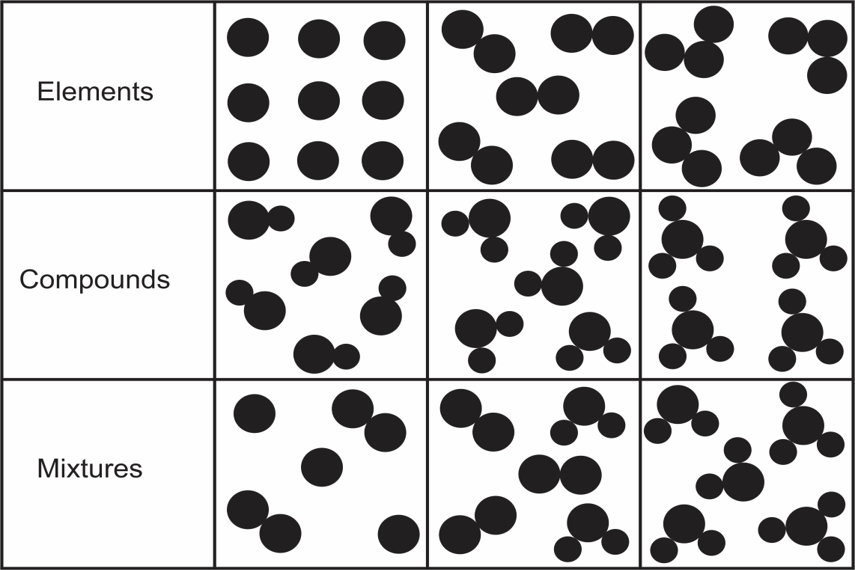
Q 34. How to identify an element, compound and mixture. Show diagrams.
Ans. If the particles are formed of same type of atoms, then they are elements. If the particles contain different type of atoms combined then they show compounds. If different type of elements or compounds are mixed, they form mixtures.
The following diagram shows elements, compound and mixtures clearly.
Q 35. Define molecule. Differentiate between molecules of elements and compounds . Give examples.
Ans. The particles which can exist freely (independently) is called molecule. Molecules of elements have same types of atoms. For example, He, H2, O3 and S8 are the molecules of helium, hydrogen and sulphur respectively.
On the other hand, the molecules of compounds have different types of atoms. For example, HCl, H2O and C12H22O11 are the molecules of hydrogen chloride, water and sucrose (table sugar) respectively.
Q 36. What are monoatomic and polyatomic molecules? Give examples.
Ans. The molecules which consist of one atom only are called monoatomic molecules. For example, He and Ne are monoatomic molecules of helium and neon respectively. All inert gases or noble gases are monoatomic molecules.
On the other hand, the molecules having two or more atoms in them are called polyatomic molecules. For example, H2, CO2 and C6H12O6 are polyatomic molecules of hydrogen, carbondioxide and glucose respectively.